I have a theory about cities.If you really want to understand one, don't only visit its shiny new stuff.Find out what it kept.That's especially true in Greenville's West End.Today you can walk down

Dated: September 25 2026
Views: 0
I have a theory about cities.
If you really want to understand one, don't only visit its shiny new stuff.
Find out what it kept.
That's especially true in Greenville's West End.
Today you can walk down South Main Street, grab dinner, pass new apartments and shops, and end up at Fluor Field at the West End watching the Greenville Drive.
It feels thoroughly modern.
But look closer.
The ballpark is covered with more than 500,000 reclaimed bricks from old Upstate textile mills. Across Field Street sits the actual former home of one of baseball's most famous—and most debated—players.
And a few miles away there's still a ballfield beside an old textile mill where he once played.
That's Greenville.
New city. Old stories. Same place.
And baseball happens to be a pretty good way to see it.
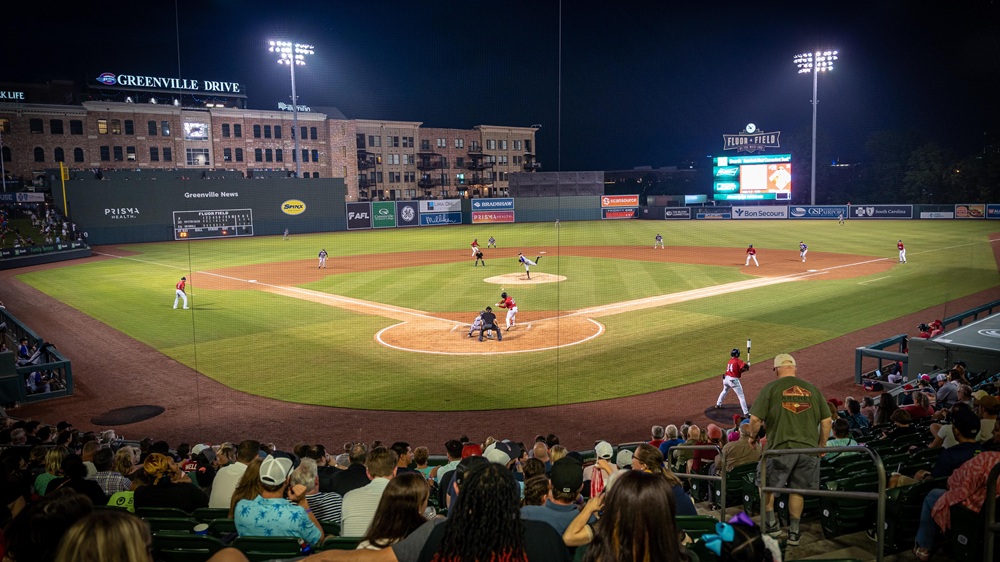
The Greenville Drive wrapped up its 2026 home schedule earlier this month.
The final home game drew 7,107 fans—a new Fluor Field attendance record.
That probably shouldn't be surprising.
In 2025, the Drive led the South Atlantic League in attendance for the seventh consecutive season and welcomed its six-millionth fan since the team began playing in Greenville.
Think about that.
Six million people have walked through the gates of a minor-league ballpark in a city of Greenville's size.
Clearly, we're either really committed to baseball...
or really committed to hot dogs.
Probably both. 😂
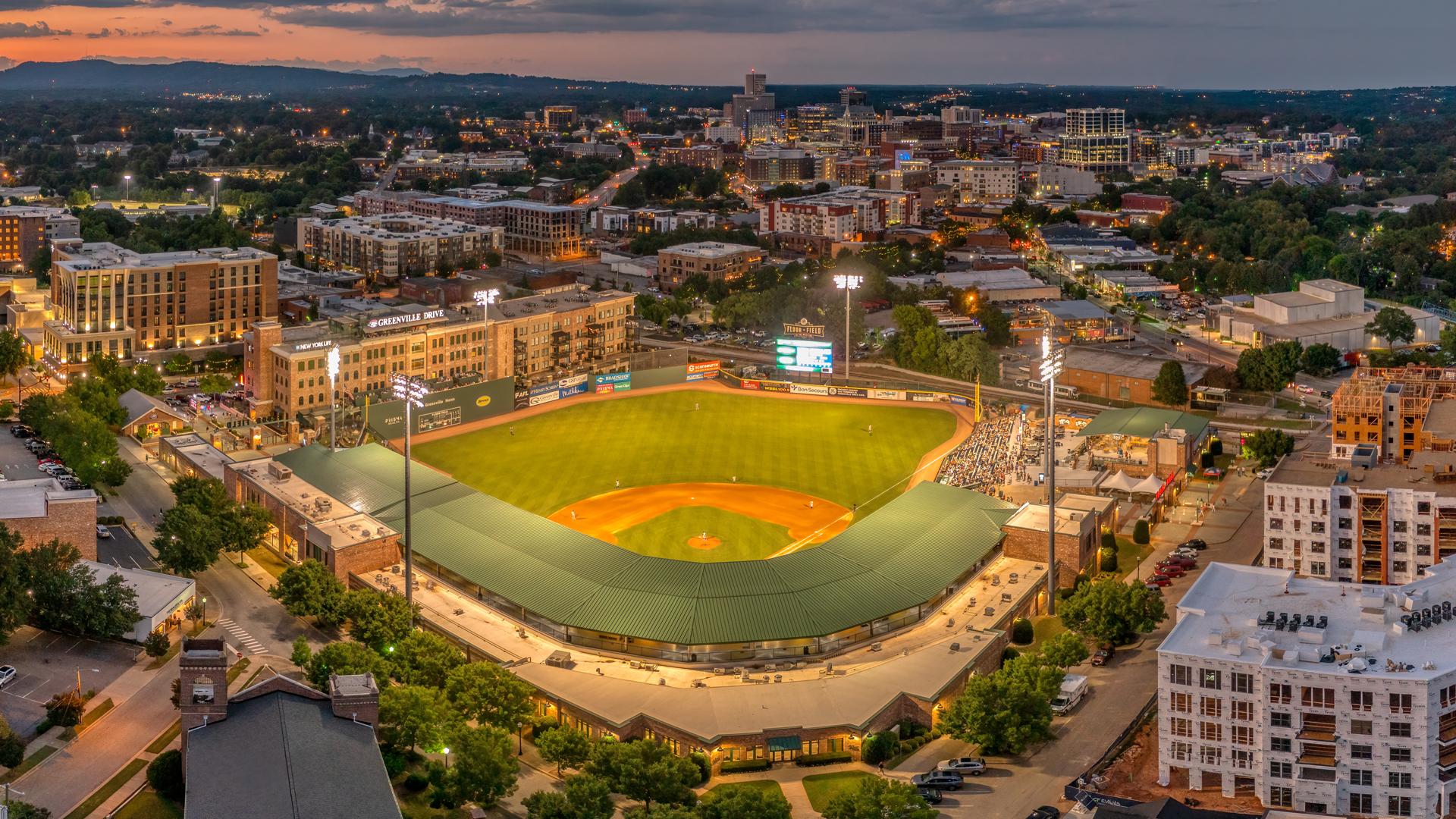
Fluor Field opened in April 2006 as the home of the Drive, the High-A affiliate of the Boston Red Sox.
If it looks vaguely familiar to baseball fans, that's intentional.
The 6,700-capacity stadium mirrors the dimensions of Boston's Fenway Park and includes its own 30-foot “Greenville Monster,” manual scoreboard and Pesky's Pole.
But my favorite design feature isn't the Green Monster.
It's the brick.
Those half-million reclaimed bricks connect the ballpark to the textile mills that once drove Greenville's economy.
That's a small architectural decision with a big message:
Don't pretend this place doesn't have a past. Build the next chapter with it.
We've seen Greenville do that over and over.
Old mills become apartments and restaurants.
Rail corridors become trails.
Industrial land becomes parks.
And reclaimed mill bricks become a baseball stadium.
When Fluor Field opened, the West End was already beginning to change.
But the ballpark became a major anchor.
The Drive describes Fluor Field as a catalyst in the West End's redevelopment, and the stadium has become something of a community gathering place—sometimes called Greenville's “front porch.”
I think that's exactly right.
Go to a game and look around.
Kids.
Grandparents.
Young professionals.
Company groups.
People who can explain every statistic on the scoreboard.
People who have absolutely no idea what's happening but know when to clap.
Everybody belongs. 😂
That's what a good community amenity does.
It gives people a reason to be together.
Walk across Field Street from Fluor Field and you'll find one of Greenville's best little hidden gems:
Shoeless Joe Jackson Museum and Baseball Library.
And the building itself is the story.
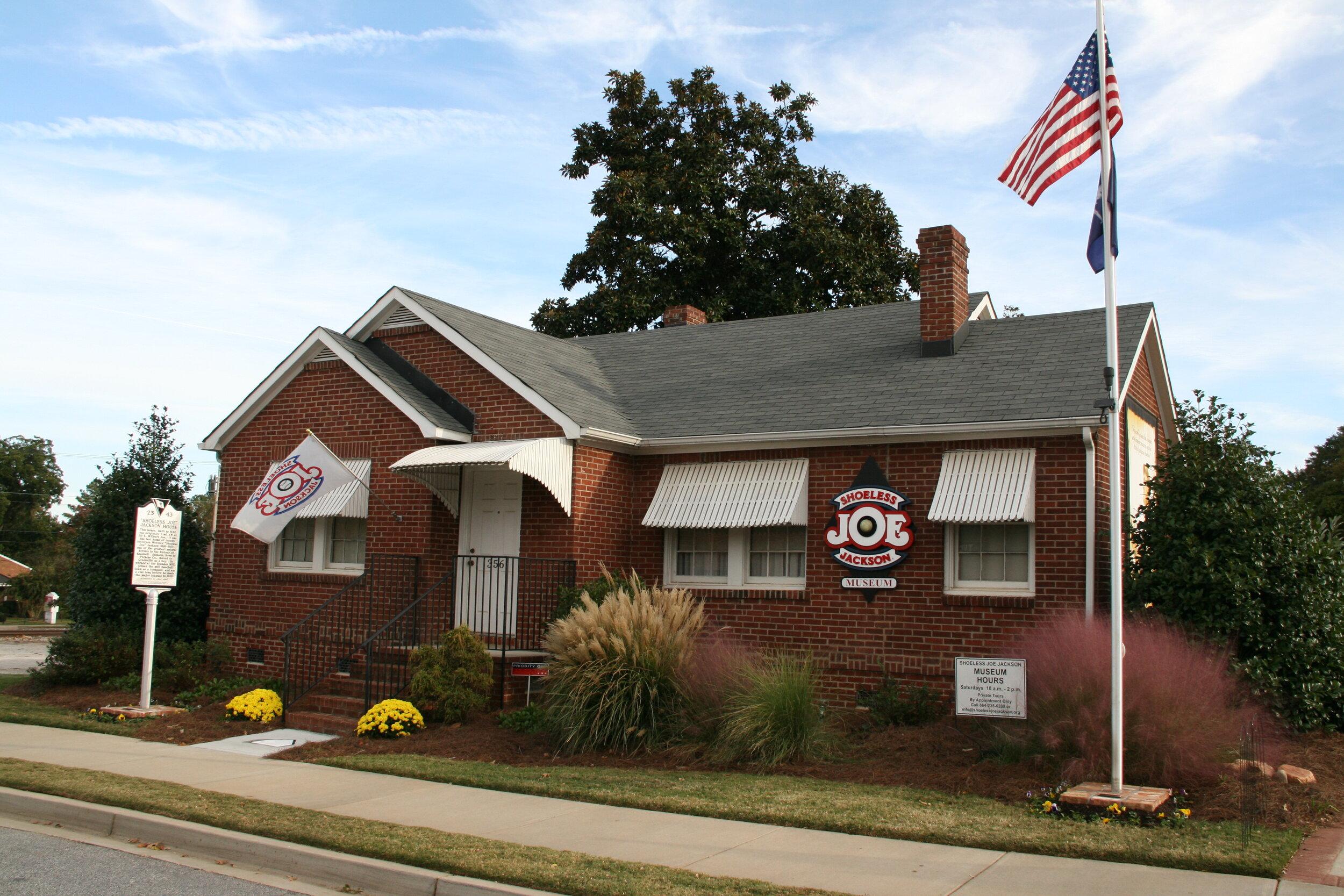
It's the house where Shoeless Joe Jackson and his wife Katie lived.
The home was moved to the West End and converted into a nonprofit museum devoted to Jackson's life, baseball career and the history of the game. In 2020, the building was moved about 100 yards again and expanded, roughly doubling the museum's space.
Apparently even Shoeless Joe's house has experienced Greenville's real-estate market.
Location, location, location. 😂
Today the museum contains photographs, records, artifacts, film and baseball literature. Admission is free, and its current public schedule is Saturdays from 10 a.m. until 2 p.m.
Jackson was born in Pickens County and grew up around Greenville's textile-mill culture. He became one of the great hitters of his era.
In 1911, his first full major-league season, he hit .408—still the highest batting average by a rookie in Major League history. Even a nearby Greenville apartment development, .408 Jackson, was named for that number.
But Jackson's legacy is inseparable from the 1919 Black Sox scandal, when members of the Chicago White Sox were accused of conspiring to lose the World Series.
Jackson and seven teammates were eventually banned from organized baseball.
More than a century later, arguments about Jackson's role continue.
That's exactly why I like having the museum here.
History is more interesting when we don't sand off the complicated parts.
Greenville can say:
This person came from here. This happened. Come learn the story.
Here's where baseball becomes Greenville history.
Textile mills weren't simply workplaces.
They created entire communities.
Homes.
Stores.
Churches.
Schools.
And baseball teams.
Mill baseball was serious business in the Upstate, and talented players could become local celebrities.
Jackson played textile-league baseball at Brandon Mill before becoming a professional player.
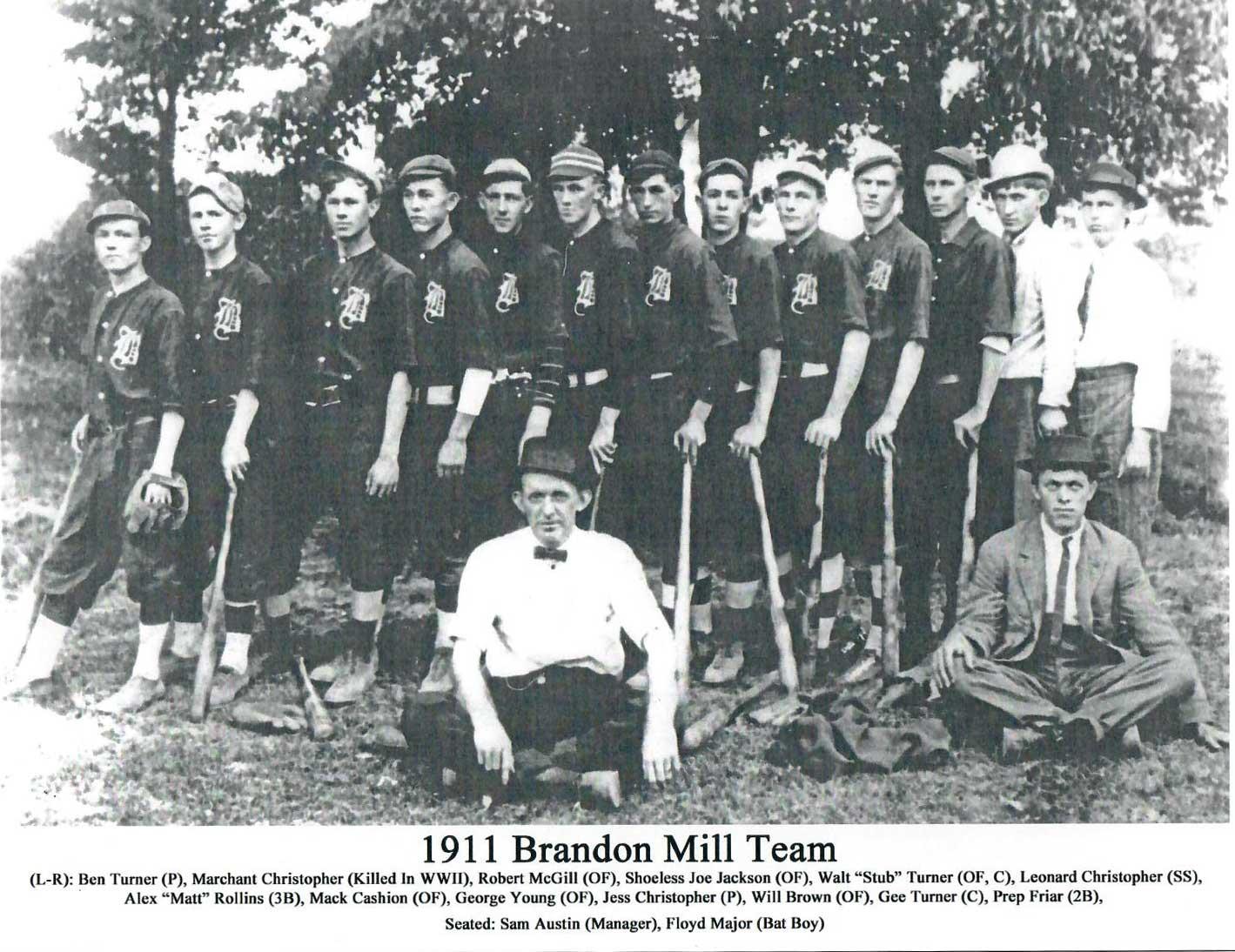
Today, you can still visit Shoeless Joe Jackson Memorial Park, an eight-acre park behind Brandon Mill with a ballfield on the property where Jackson once played.
So within Greenville, you can trace the story from:
Mill village baseball → Shoeless Joe → modern minor-league baseball at Fluor Field.
That's a pretty good local history lesson.
Here's the timely reason I especially like this topic today.
Upcountry History Museum is currently hosting Picturing America's Pastime, an exhibition organized by the National Baseball Hall of Fame and Museum.
Greenville is the exhibition's only stop in the Southeastern United States.
The exhibit contains 51 rarely seen baseball photographs dating from 1866 through 2012, while the museum has partnered with the Shoeless Joe Jackson Museum to add Greenville and Upstate baseball artifacts and memorabilia.
It's on display through January 24, 2027.
Now that is an event worth mentioning because it tells a larger Greenville story.
This may be the part I like most.
About half of the Drive's home games now incorporate some form of community engagement, from recognizing teachers and first responders to highlighting industries important to the Upstate.
One of its best-known initiatives is the Reading All-Stars program, created with Michelin to encourage children to read. The program has expanded into six counties and, according to the Drive, has reached more than 1.3 million students.
That's when a sports team becomes a civic institution.
Baseball is the excuse to gather.
Community is the bigger idea.
Nobody chooses Greenville because we have minor-league baseball.
At least I don't think anyone has ever called me and said:
“Eric, our entire relocation decision depends on the quality of the left-field wall.”
Although I'd respect the commitment. 😂
But places like Fluor Field tell you something about how a city lives.
Can you walk to entertainment?
Do families have affordable things to do?
Does the city preserve its history?
Are there gathering places?
Can you go to dinner, walk to a game and stroll through downtown afterward?
Those little lifestyle questions become pretty important once Greenville stops being somewhere you're visiting and becomes somewhere you're living.
This is why I enjoy the West End.
It's not frozen in history.
And it hasn't erased history either.
You've got old brick buildings beside new construction.
The Swamp Rabbit Trail.
Restaurants.
Fluor Field.
Arts.
The Shoeless Joe Museum.
Falls Park just up Main Street.
And reminders everywhere that Greenville used to be a very different place.
That's a city becoming something new without completely forgetting what it was.
I think that matters.
My Why Greenville SC guide is designed to help people understand these lifestyle and community pieces before choosing where they want to live.
When you're ready to explore the housing side, you can browse Greenville and Upstate homes for sale.
And if Greenville is part of your retirement plan, downtown entertainment, walkability, museums, sports and community life may all be part of your decision. I've built a separate resource at Retiring in Greenville SC.
The next time you're in the West End, slow down.
Don't simply go to dinner and leave.
Walk around Fluor Field.
Look at those old mill bricks.
Cross Field Street and find Shoeless Joe's house.
Then walk north toward Falls Park.
In less than a mile, you'll move through Greenville's textile past, its baseball history, its revitalized West End and one of the most recognizable downtown parks in America.
That's why these stories matter.
You can learn a lot about Greenville without ever opening a history book.
Sometimes you just have to walk around and pay attention.
I'm Eric Mitchell, a longtime Greenville local and Realtor®, and helping people discover the stories behind the Greenville lifestyle is one of my favorite parts of what I do.
Who you hire matters.
Call, text or email... I promise, I won't leave you hanging.
Fluor Field is at 945 South Main Street in Greenville's West End, within walking distance of Falls Park and the downtown Main Street corridor.
The Greenville Drive play at Fluor Field. The Drive is the High-A affiliate of the Boston Red Sox and has played in Greenville since 2006.
Fluor Field was designed with field dimensions that mirror Boston's Fenway Park. It includes a 30-foot Greenville Monster in left field, a manual scoreboard and Pesky's Pole in right field.
Yes. The museum occupies the former home of Joe and Katie Jackson. The house was relocated to Greenville's West End and later moved about 100 yards in 2020 as part of an expansion that roughly doubled the museum's size.
Admission is currently free. The nonprofit museum relies on donations and gift-shop sales and currently lists regular public hours of Saturday from 10 a.m. to 2 p.m. Check its schedule before making a special trip.
Yes. Baseball was an important part of Upstate textile-mill communities long before the Greenville Drive arrived. Shoeless Joe Jackson played textile-league baseball at Brandon Mill, and today's Shoeless Joe Jackson Memorial Park includes a ballfield on the property where he played.
The core West End around South Main Street, Fluor Field and Falls Park is pedestrian-oriented, with restaurants, shops and attractions relatively close together. Whether you can live car-light depends heavily on the exact property and your work and daily needs.
For someone who values restaurants, arts, sports, parks and walkability, downtown and the West End can be appealing. I'd also compare HOA costs, parking, healthcare access, home style and how much driving you expect to do before deciding whether urban Greenville fits your retirement lifestyle.

With 28 years of experience in media marketing sales and an in-depth knowledge of every corner of the Greenville market, I’ve built my real estate career on one simple principle: exceptional com....
I have a theory about cities.If you really want to understand one, don't only visit its shiny new stuff.Find out what it kept.That's especially true in Greenville's West End.Today you can walk down
Today’s housing market splits into four distinct types. You’ve got cash buyers, buyers financing a purchase, owners who feel locked into a low rate, and builders with homes to sell.
🎭 Greenville’s Arts Scene Is Much Bigger Than You Might ThinkWhen people are considering moving to Greenville, I hear plenty of questions about the usual things.What's downtown like?How are
Is Now a Good Time to Buy a Home in Greenville SC? What the Latest Market Data Really SaysIf you've watched the news lately, I understand why you might be nervous about buying a house.Mortgage rates
 Information deemed reliable but not guaranteed.
Property information provided courtesy of the Internet Exchange Program of the Greenville Association of Realtors.
The information being provided is for consumers personal, non-commercial use and may not be used for any purpose other than to identify prospective properties consumers may be interested in purchasing.
Data is updated as of September 25, 2026 5:12 PM UTC
Information deemed reliable but not guaranteed.
Property information provided courtesy of the Internet Exchange Program of the Greenville Association of Realtors.
The information being provided is for consumers personal, non-commercial use and may not be used for any purpose other than to identify prospective properties consumers may be interested in purchasing.
Data is updated as of September 25, 2026 5:12 PM UTC
