

First-Time Home Buyer Guide to Greenville, SC
Everything you need to know about buying your first home in Greenville and the Upstate — without needing a real estate dictionary.
Buying your first home is exciting. It's also completely normal to have about 847 questions.
How much money do I need? Do I need 20% down? What's a pre-approval? What are closing costs? What happens during an inspection? And exactly when do I get the keys?
That's why I created this guide.
I'm Eric Mitchell, REALTOR® and team leader of The Eric Mitchell Team with Berkshire Hathaway HomeServices C. Dan Joyner, REALTORS®. I've spent my career helping buyers and sellers throughout Greenville and the Upstate, and one of my favorite things is helping a first-time buyer go from “I have no idea where to start” to “I own a home!”
Buying your first home can feel complicated.
My job is to make it feel a whole lot less complicated.
🏡 Think You Need 20% Down? Think Again.
One of the biggest myths about buying your first home is that you need a 20% down payment.
You don't necessarily.
Some conventional mortgage programs allow qualified buyers to put as little as 3% down, while FHA financing can allow qualified borrowers to put down as little as 3.5%. In fact, Freddie Mac reports that the median down payment among first-time buyers in 2025 was 10%, not 20%.
There are also USDA and VA programs that can provide qualified borrowers with no-down-payment options, depending on the buyer and property.
The point isn't that everyone qualifies for the same program. The point is this: don't decide you can't buy a home before you've found out what's actually possible.
That's why financing is one of the very first conversations we'll have.
🔑 Your First Home Roadmap
1. How Much Money Do I Need to Buy a Home?
2. First-Time Buyer Mortgage Options
3. South Carolina First-Time Buyer Assistance
4. Meet My Lending Partner, Kevin Dobbins
5. The Mitchell Method: My 7-Step Home-Buying Process
6. Step 1: Let's Talk About You
7. Step 2: Get Pre-Approved
8. Step 3: Find Your Part of the Upstate
9. Step 4: Let's Go House Hunting
10. Step 5: Making the Offer
11. Step 6: Inspections, Appraisal & Financing
12. Step 7: Closing Day — You Get the Keys!
13. Buying New Construction vs. Resale
14. Moving to Greenville From Out of Town?
15. Common First-Time Buyer Mistakes
16. First-Time Buyer FAQs
17. Ready to Take the First Step?
How Much Money Do I Need to Buy My First Home in Greenville?
Here's where first-time buyers sometimes get overwhelmed.
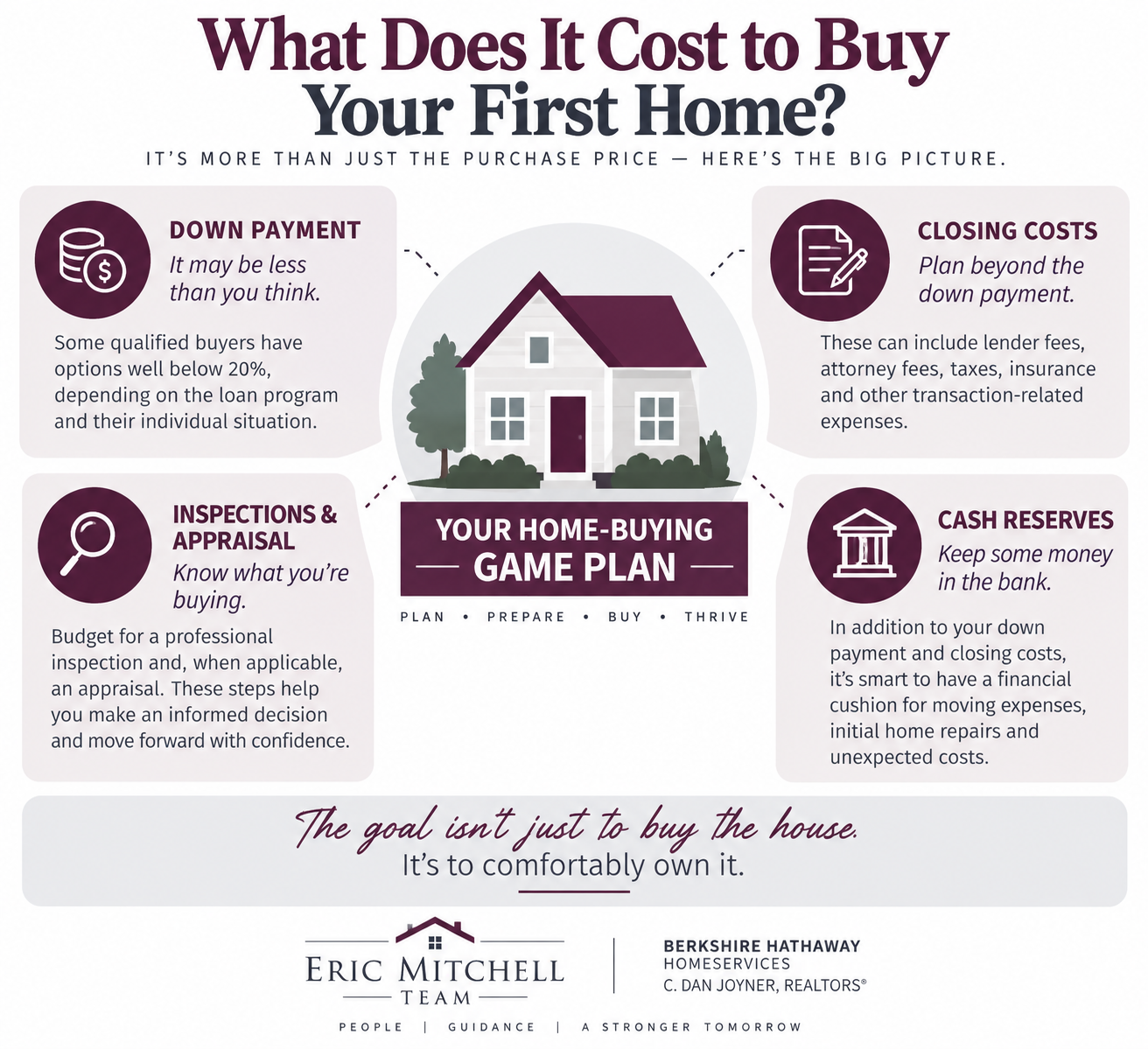
Your down payment isn't the only number we need to think about. Your home-buying budget may include:
Down payment + closing costs + inspections/appraisal + moving expenses + money you want to keep in reserve.
And here's something important:
The goal isn't to spend every dollar you have just to get into a house.
I want you to enjoy owning the house after you buy it.
If buying leaves you with $14.72 in your checking account and you're eating ramen noodles until Christmas, we probably need a different plan. 😉
Your lender can help determine how much you can borrow. I also want to talk about how much you are comfortable spending every month.
Those aren't always the same number.
💡 ERIC'S TIP
Don't shop based solely on the maximum amount you're approved to borrow.
Start with the monthly payment that fits comfortably into your life. Then we'll build your home search around that number.
What Types of Mortgages Are Available to First-Time Buyers?
There isn't one special mortgage called “the first-time buyer loan.”
Instead, buyers may qualify for several different loan programs. Kevin's lending material identifies four of the most common: Conventional, FHA, USDA and VA.
Conventional Loan
Conventional financing is one of the most common options. Depending on the particular program and borrower's qualifications, down payments can be as low as 3%.
FHA
FHA loans are insured by the Federal Housing Administration and can be particularly useful for buyers who need more flexibility with their down payment or credit profile.
Qualified borrowers may be able to put down as little as 3.5%.
USDA Loans
This one sometimes surprises people.
USDA's guaranteed loan program can provide 100% financing with no down payment to qualified buyers purchasing eligible properties in eligible rural areas.
And “rural” doesn't always mean middle of nowhere. When we're searching outside Greenville's urban core, it's worth asking Kevin whether a property and buyer might qualify rather than assuming they won't.
VA Loans
For eligible Veterans, service members and certain surviving spouses, VA-backed loans can be an outstanding option. VA says nearly 90% of its backed home loans are made without a down payment, and VA-backed purchase loans generally don't require PMI.
So which mortgage is best?
That's exactly why I don't try to play mortgage lender.
My lane is real estate. Kevin's lane is mortgages.
We'll work together so you understand how your financing affects the homes we should consider and how we structure your purchase.
Are There First-Time Home Buyer Programs in South Carolina?
Yes — and this is one reason I don't want buyers assuming they aren't ready.
Programs may be available to help qualified South Carolina buyers with down payments and/or closing costs. Eligibility can depend on income, credit, property, loan type, purchase price and other requirements.
And programs change.
That's why I'm deliberately not going to tell you, “You qualify for XYZ program because you make $XX,XXX.”
That's Kevin's department.
One current example: Flex Funds
Stone Mortgage currently has a Flex Funds program that can provide eligible first-time buyers with up to $4,000 that can be applied toward down payment or closing costs.
There are qualification requirements, including income limits and specific loan requirements, so this isn't $4,000 available to everyone. Kevin can determine whether it's an option for you.
💡 ERIC'S TIP
Don't assume you make too much money for assistance. Don't assume you make too little to buy. And don't assume you need tens of thousands of dollars saved.
Have the conversation first. Then you'll know.
Meet Kevin Dobbins of Stone Mortgage

One reason I enjoy working with Kevin Dobbins at Stone Mortgage is that we have a similar philosophy about communication.
Kevin is an Upstate South Carolina native and has worked in the mortgage business since 2017. His goal is to take something that can seem complicated and intimidating and make it understandable, while helping clients understand why they're making a particular financial decision.
Sound familiar? 😉
That's particularly important with first-time buyers.
Kevin Dobbins
Senior Mortgage Banker | NMLS #1663033
Stone Mortgage
📱 864-752-7237
✉️ kevin@gostonemortgage.com
Okay...So How Do I Actually Buy the House?
Once we've figured out the financial side, it's time for the fun part.
Over the years, I've found that first-time buyers are much less stressed when they know what happens next.
So instead of throwing you into the deep end and shouting “Good luck!”, I break the process into seven manageable steps.
I call it:
The Mitchell Method 7 Steps From “Could I Buy a Home?” to “I Got the Keys!” 🔑
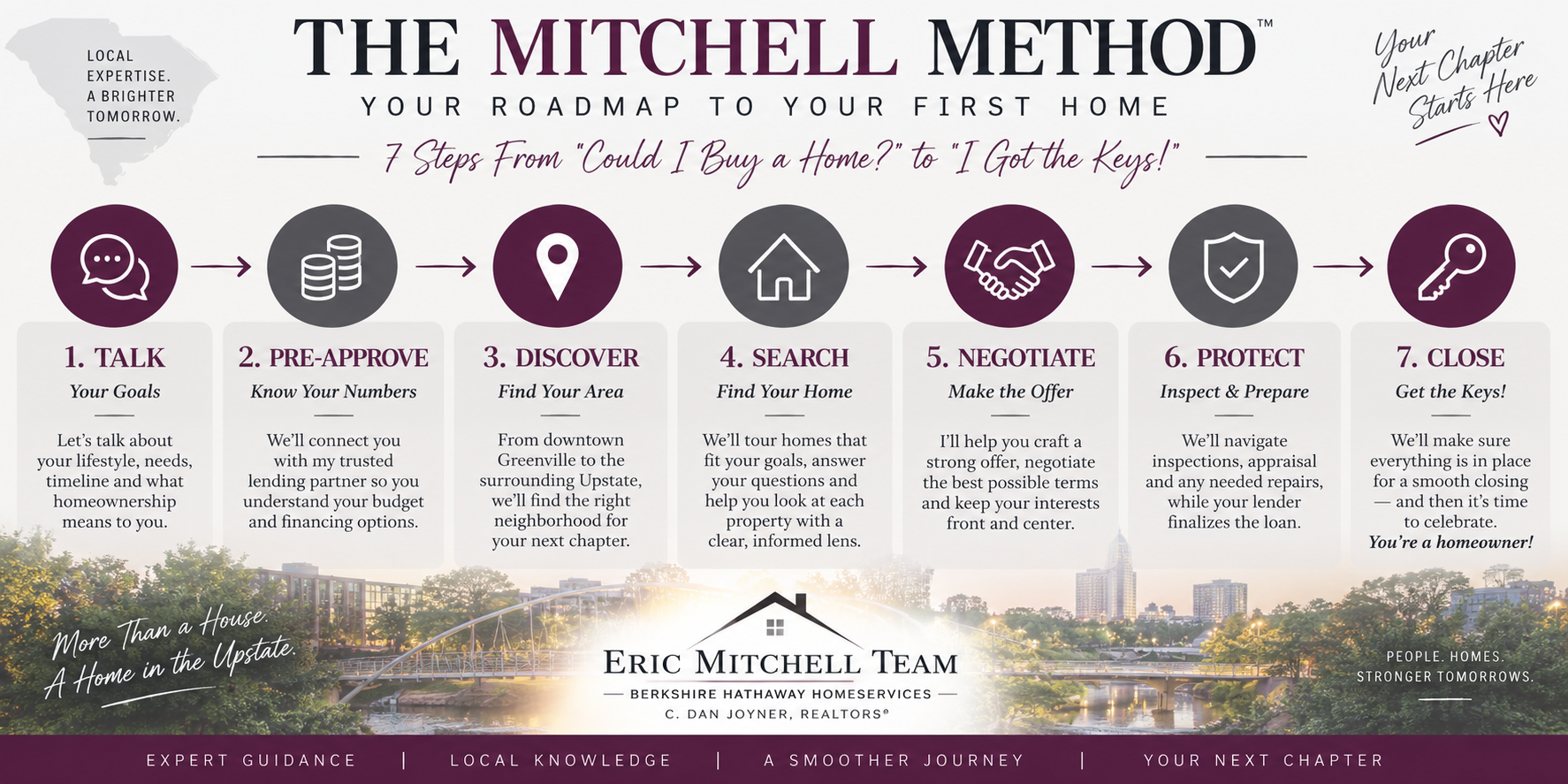
Step 1: Let's Talk About You
Before we look at houses, I want to know what you're trying to accomplish.
Where do you work? What does your normal week look like? Do you want to be close to Downtown Greenville, or would you rather have a little more elbow room? Is a short commute important? Yard? Home office? Walkability? Schools? Garage? Room for the dog?
And maybe the biggest question:
What would make owning a home better than where you're living now?
This first conversation isn't a sales pitch. It's simply about figuring out where you are, where you'd like to go, and what needs to happen to get you there.
You don't even have to be ready to buy.
I've talked with plenty of buyers who were months away from making a move. Sometimes knowing what needs to happen next is the most valuable thing we can accomplish.
💡 ERIC'S TIP
Don't wait until you're “ready” to talk with a Realtor or lender. An early conversation can help you create the roadmap that gets you ready.
Step 2: Get Pre-Approved
This is where Kevin comes back into the picture.
Before we seriously start shopping, you'll want to know what financing options are available to you and, more importantly, what monthly payment feels comfortable.
A mortgage pre-approval can help us understand your price range and also puts us in a much stronger position when it's time to make an offer.
Kevin may ask you for information about your income, employment, assets, debts and credit. He'll then help you understand the financing options that may fit your situation.
And remember:
The maximum amount you're approved for doesn't have to be the amount you spend.
I would much rather help you find a home that leaves room in your budget for vacations, dinners downtown and, inevitably, the trip to Lowe's you didn't know you needed. 😁
Step 3: Find Your Part of Greenville & the Upstate
This is one of my favorite parts.
Greenville may be the center of my business, but I work throughout the Upstate. Depending on your budget, commute and lifestyle, your search might include Greenville, Greer, Simpsonville, Mauldin, Travelers Rest, Fountain Inn, Easley, Taylors or somewhere in between.
There isn't one “best” place to live.
There's the place that works best for you.
Someone who wants to walk to restaurants may have completely different priorities from someone who wants a larger yard and quieter surroundings.
We'll talk about what matters to you and then explore the communities that fit.
💡 ERIC'S TIP
Don't fall in love with a ZIP code before you've figured out the lifestyle you want. Sometimes the perfect house is ten minutes beyond the area you originally thought you had to live in.
Step 4: Let's Go Find the House 🏡
Okay. Now we get to look at houses.
We'll set up a search based on your price range, location and priorities. As homes hit the market, we'll narrow down which ones are worth seeing.
But here's where having an experienced agent matters.
We're not just looking at whether you like the kitchen.
I'm looking at the whole picture.
How long has the home been on the market? Has the price changed? How does it compare with recent sales? Are there things about the property that could affect resale? Does the neighborhood fit what you've told me you want?
And sometimes...
the house that's been sitting on the market for a while deserves a second look.
In a market with more inventory, longer days on market can create opportunities for buyers to negotiate on price, repairs, closing costs or other terms.
Pretty pictures get us through the front door.
The numbers and the details help us decide whether we should stay.
Step 5: Let's Make an Offer
You found it.
Now your heart rate goes up about 37%. 😂
Before we write anything, I'll help you understand the home's value, comparable sales, market activity and the seller's situation as much as we're able to determine.
Then we'll decide together:
What price makes sense?
But price isn't the only part of an offer.
We'll also consider financing, earnest money, due diligence, closing date, inspections, requested seller concessions and other terms that can make an offer more—or less—attractive.
My job isn't simply to write the paperwork.
My job is to help you make a smart decision and negotiate from the strongest position we reasonably can.
And if we can't reach terms that make sense?
There will be another house.
Sometimes one of the best negotiations is knowing when not to force the deal.
Step 6: Inspections, Appraisal & Getting to Closing
Congratulations! You're under contract.
Now we start looking under the hood.
I strongly recommend that buyers have the home professionally inspected. Depending on the property, additional inspections or evaluations may also make sense.
The purpose isn't to find a perfect house.
Spoiler alert: there aren't any.
It's to understand what you're buying.
We'll review the inspection findings and determine whether there are items we should address with the seller under the terms of your contract.
At the same time, Kevin and his team will continue working through your financing. Your lender may order an appraisal, verify documentation and work toward final loan approval.
You'll also arrange homeowners insurance and we'll keep track of the various deadlines leading to closing.
There are quite a few moving parts here.
That's why communication matters.
You shouldn't have to wonder what's happening with the biggest purchase you've probably ever made.
Step 7: Closing Day
We made it!
Before closing, we'll do a final walk-through of the property to make sure it's in the expected condition and that any agreed-upon items have been addressed.
Then you'll sign your closing documents, your attorney will handle the legal side of transferring ownership, and once everything is completed...
You become a homeowner.
🔑 You get the keys!
It's a pretty great moment.
And here's something else that's important to me:
I'm not disappearing after closing.
If you need a plumber six months later, wonder what a renovation might do to your home's value, or just can't remember who I recommended for HVAC work, call me.
I want to be your real estate resource long after someone hands you the keys.
NEW CONSTRUCTION VS. RESALE
Should a First-Time Buyer Consider New Construction?
Absolutely.
A lot of first-time buyers assume a newly built home will automatically cost more than an existing home. That's not always the case, especially when builders are trying to move inventory and may provide incentives toward closing costs, financing or upgrades.
New construction can also be appealing because you're starting with new systems, appliances, roofing and finishes.
But here's the important part:
The builder's sales representative represents the builder. Not you.
Having your own Realtor gives you someone looking at the transaction from your side of the table.
I can help you compare the builder's incentives, contract terms, location, future development around the community and how the home may compare with resale alternatives.
And yes, I recommend inspections on new construction, too.
New doesn't necessarily mean perfect.
💡 ERIC'S TIP
If you're interested in new construction, call me before your first visit to the model home. Some builders have specific requirements about when and how your Realtor must be registered with you.
This is a big one for me because I work with a lot of people relocating to Greenville and the Upstate.
Buying your first home is already a new experience.
Buying your first home in a city where you don't live yet adds another layer.
That's where having someone local really matters.
I'm a lifelong Greenvillian, and my job isn't to convince you that one particular neighborhood is where you should live. It's to help you understand the different parts of the Upstate so you can decide what fits you.
We can start with a phone or video conversation and talk about your job location, commute, lifestyle, budget and priorities.
From there, I can help you understand areas including Greenville, Greer, Simpsonville, Mauldin, Travelers Rest, Fountain Inn, Easley, Taylors and other Upstate communities that may fit your search.
If you can't be here for every showing, technology makes that a whole lot easier.
I've helped relocation buyers evaluate homes remotely with video, FaceTime and plenty of communication along the way.
💡 ERIC'S TIP
When you're relocating, don't choose an area based solely on a “Top 10 Neighborhoods in Greenville” article you found online.
Start with your lifestyle. Then we'll figure out which areas deserve a closer look.
Is Greenville a Good Market for First-Time Home Buyers?
There isn't really a universal “good” or “bad” time to buy.
There's a good time for you to buy.
That depends on your finances, how long you expect to stay in the area, your monthly housing alternatives and what homes are available within your budget.
But today's Greenville and Upstate market does give buyers something they didn't have much of during the frenzy a few years ago:
Choices.
With more homes available and many properties taking longer to sell, buyers can often take a little more time to evaluate their options.
Some sellers may also be willing to negotiate on things like price, repairs, closing costs or other terms.
That doesn't mean every seller is desperate or every house is a bargain.
It means strategy matters.
Sometimes the shiny new listing that hit the market yesterday isn't where we'll find our best opportunity.
Sometimes it's the perfectly good house that's been sitting there for 45, 60 or 90 days.
💡 ERIC'S TIP
Don't automatically skip homes that have been on the market longer.
Longer days on market can sometimes create an oppo
7 First-Time Home Buyer Mistakes I'd Love to Help You Avoid
1. Waiting Until You Have 20% Down
As we've already discussed, 20% isn't always required. Talk with a knowledgeable lender before assuming homeownership is years away.
2. Shopping Before Getting Pre-Approved
It's awfully easy to fall in love with a $500,000 house when your comfortable budget is $375,000.
Let's get the numbers figured out first.
3. Focusing Only on the Purchase Price
Your monthly housing expense can include principal, interest, property taxes, homeowners insurance, HOA fees and possibly mortgage insurance.
The monthly number matters.
4. Draining Your Savings to Buy
Owning a home means eventually something will need attention.
Keep some money in reserve.
Your future water heater has no idea you just spent all your money on closing costs. 😂
5. Making Big Financial Changes Before Closing
This is important.
Don't finance the new furniture yet.
Avoid opening new credit cards, financing a vehicle, changing jobs or making other significant financial moves without talking to your lender first.
Something that seems harmless could affect your mortgage approval.
6. Skipping the Home Inspection
A home inspection costs money.
So does replacing a roof, repairing a crawlspace or discovering an electrical problem after you own the house.
I strongly recommend understanding what you're buying.
7. Trying to Do Everything Alone
You don't need to become an expert in mortgages, contracts, inspections, appraisals, negotiations and South Carolina real estate law.
That's why you build a good team around you.
You bring the dream. We'll help with the details.
Do I Have to Pay My Realtor as a Buyer?
This deserves its own section because the rules around buyer-agent compensation have changed in recent years, and first-time buyers understandably have questions.
Before we begin touring homes together, we'll discuss how buyer representation works, what services I provide and how my compensation will be handled. We'll also put our relationship in writing through a buyer agreement.
Depending on the transaction, there may be opportunities to negotiate for the seller to contribute toward buyer-agent compensation as part of the purchase agreement.
The important thing is that we'll discuss all of this upfront.
No surprises.
I want you to understand who I represent, what I'm doing for you and how everyone involved in the transaction is being compensated.
💡 ERIC'S TIP
Never be embarrassed to ask your Realtor, lender or closing attorney, “What does that mean?”
This may be our everyday business. It isn't yours. You deserve an explanation you actually understand.
Frequently Asked Questions About Buying Your First Home in Greenville, SC
How much money do I need to buy my first home in Greenville, SC?
It depends on your loan program, purchase price and individual financial situation.
Some qualified buyers may have conventional financing options requiring as little as 3% down, while FHA financing may require as little as 3.5% down. USDA and VA programs can potentially provide zero-down-payment financing for eligible borrowers and properties.
But your down payment isn't the only expense to consider. You'll also want to plan for closing costs, inspections, appraisal costs when applicable, moving expenses and some money left in reserve.
Don't assume you need 20% down before talking with a lender.
What credit score do I need to buy a house?
There's no single credit score required for every mortgage.
Different loan programs and lenders have different requirements, and your credit score is only one part of your overall financial picture.
Rather than picking a number from the internet and deciding whether you qualify, talk with a mortgage professional.
Even if you're not ready today, Kevin can help you understand what may need to improve so you have a roadmap for getting there.
Do first-time home buyers need 20% down?
No.
That's probably the biggest first-time buyer myth I hear.
Depending on qualifications and loan program, some buyers may be able to purchase with 3% or 3.5% down, and eligible USDA or VA borrowers may have zero-down options.
A 20% down payment can have advantages, but it isn't the universal admission price for homeownership.
Are there first-time home buyer programs in South Carolina?
Yes. Qualified buyers may have access to various mortgage and down-payment-assistance programs.
Eligibility can depend on factors including income, credit, property location, household circumstances and loan type.
Stone Mortgage also currently has its Flex Funds program, which may provide eligible first-time buyers with up to $4,000 toward a down payment or closing costs, subject to program requirements.
Programs change, so rather than relying on an old article you found online, ask Kevin what's available now.
How much are closing costs in South Carolina?
Closing costs vary significantly based on the home, mortgage, insurance, taxes, attorney, lender and other transaction expenses.
That's why I don't like giving buyers a magic percentage and pretending it's going to be accurate for everyone.
Your lender will provide estimates of your loan-related closing costs, and we'll also discuss other expenses associated with your purchase.
In some transactions, we may also be able to negotiate for the seller to contribute toward allowable buyer closing costs.
Should I get pre-approved before looking at houses?
Yes.
You don't necessarily need a pre-approval just to have an initial conversation with me, but you need to have one before we begin seriously shopping for a house.
It tells us what financing may be available, helps establish a realistic price range and makes you better prepared when we find the right home.
There's nothing fun about finding THE house on Saturday and discovering we can't make a competitive offer because we're still trying to figure out financing...and then it's under contract on Sunday. It happens!
How long does it take to buy a house?
The searching part could take a weekend or several months. There's no universal timeline.
Once you're under contract, the closing timeline depends on the terms of your contract, financing and other factors.
That's another reason I encourage buyers to start the conversation before they're under pressure to move.
If you tell me, “My lease ends in six months,” fantastic.
We can work backward and build a plan.
Should I have a home inspection?
I strongly recommend it.
A professional inspection helps you better understand the condition of the home you're purchasing.
An inspection isn't about creating a giant list of every scratch and squeaky hinge.
Depending on what the inspection uncovers and the terms of the contract, we may focus our repair discussions on important items involving systems such as electrical, plumbing, roofing, foundation or HVAC rather than every minor cosmetic issue.
And yes, I recommend inspections on new construction, too.
Can a seller pay my closing costs?
Potentially.
Seller-paid buyer expenses can be negotiated as part of a real estate transaction, subject to the contract and any applicable lending requirements.
Whether asking for seller concessions makes sense depends heavily on the property and market situation.
A home that's been sitting for 90 days may give us a very different negotiating opportunity than one that received five offers its first weekend.
That's where strategy comes in.
Is new construction good for a first-time buyer?
It certainly can be.
Builders may have financing incentives, closing-cost assistance or other promotions that make new construction attractive.
But compare the whole deal, not just the incentive.
We'll consider price, location, HOA, taxes, included features, future development, financing terms and how the home compares with resale alternatives.
And remember: the builder's representative works for the builder.
Having your own representation means someone is looking at the transaction from your side.
What if I'm moving to Greenville from another state?
You're definitely not alone.
I regularly work with relocation buyers throughout Greenville and the Upstate, and much of the process can begin before you ever get here.
We can talk by phone or video, narrow down communities based on your lifestyle and commute, and use video or FaceTime when you're unable to see a property personally.
Being a lifelong Greenvillian also gives me something Google can't quite replicate:
I've watched this community grow and change firsthand.
My job isn't to tell you where you should live. It's to give you good local information so you can decide where you want to live.
What areas should I consider around Greenville?
That depends entirely on you.
Your search might include Greenville, Greer, Simpsonville, Mauldin, Travelers Rest, Taylors, Fountain Inn, Easley or other communities throughout the Upstate.
Rather than starting with a list of “best neighborhoods,” I prefer to start with your budget, commute, lifestyle and priorities. I have a process that helps us match your needs, wants, and desires (I call them "sacred cows") with the appropriate home.
Then we find the areas that fit.
Is now a good time to buy a home in Greenville?
Maybe.
And that's not me dodging the question. 😁
There's an old real estate saying: “The best time to buy property was five years ago.” Another is, “Don't wait to buy real estate. Buy real estate and wait.” Of course, that only works when buying makes sense for you. Your finances, timeline and lifestyle matter more than a catchy quote.
If you're financially prepared, expect to stay in the area for a reasonable amount of time and can find a home and monthly payment that make sense for you, buying may be worth considering.
Today's market also gives buyers more choices than they had during the extreme seller's market of a few years ago.
Your circumstances matter more than a national headline. So the answer really is: when you're financially and personally ready, that's a good time to consider buying.
Do I need a Realtor when buying my first home?
You aren't just hiring someone to unlock doors.
A good buyer's agent helps you evaluate properties, understand market value, structure and negotiate an offer, navigate inspections, monitor contract deadlines, coordinate with the lender and closing attorney, and help protect your interests throughout the transaction.
For a first-time buyer, I think there's another important job:
Explaining what's happening and why.
You should never feel embarrassed asking me a question.
This is what I do every day.
It isn't what you do every day.
🏡 Not Sure You're Ready Yet?
That's completely fine.
You don't need to have every dollar saved.
You don't need to know exactly what neighborhood you want.
And you definitely don't need to understand every step of buying a house.
Sometimes the best first step isn't looking at homes.
It's simply having a conversation.
Tell me where you are today and where you'd eventually like to be. If you're ready now, we'll get moving.
If you're six months away, we'll create a plan.
And if you're a year or two away?
That's okay, too.
No pressure. No sales pitch. Just answers.

Ready When You Are. 🔑
Eric Mitchell, REALTOR®
The Eric Mitchell Team
Berkshire Hathaway HomeServices C. Dan Joyner, REALTORS®
📱 864-325-7054
✉️ emitchell@cdanjoyner.com
🌐 EricMitchellRealEstate.com
Call, Text, or Email... I promise, I won't leave you hanging.
 Information deemed reliable but not guaranteed.
Property information provided courtesy of the Internet Exchange Program of the Greenville Association of Realtors.
The information being provided is for consumers personal, non-commercial use and may not be used for any purpose other than to identify prospective properties consumers may be interested in purchasing.
Data is updated as of September 20, 2026 9:18 PM UTC
Information deemed reliable but not guaranteed.
Property information provided courtesy of the Internet Exchange Program of the Greenville Association of Realtors.
The information being provided is for consumers personal, non-commercial use and may not be used for any purpose other than to identify prospective properties consumers may be interested in purchasing.
Data is updated as of September 20, 2026 9:18 PM UTC
